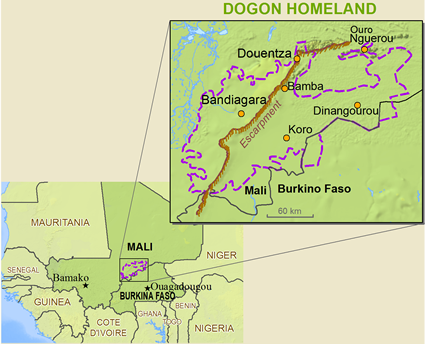
The Dogon live in a dry remote savannah area in the mid-section of Mali, stretching into Burkina Faso. Their territory includes a rocky plateau in the West and a sandy plain in the east, separated by a 400-700-meter-high sheer cliff. The Dogon built their first villages in caves in this cliff, safe from the slave raids of the Fulani nomads who roamed the area. Isolated and distrustful of outsiders, they grew into a scattering of micro-communities, eventually each with a different language. The Dogon people are divided by languages and dialects, one of which is Toro Tegu.
Life in the bare rocky cliffs is harsh. In many cases soil for gardens was brought in from the plains below, and pigeon dung collected from the cliff face was used as fertilizer. Since the Fulani have been subdued (since colonial times), the Toro Tegu Dogons have spread out from the cliff onto the plateau (where onions have been introduced as a cash crop) and into the plain (where they grow millet.) They also grow rice, sorghum, peanuts, vegetables and raise livestock.
For centuries, the Toro Tegu Dogons have resisted Islam. But as society modernizes, they are increasingly deciding that animistic religion is no longer adequate and grudgingly accept Islam, for lack of an alternative. In the few villages where Christianity has been lived out by missionaries, or locals who have become Christians elsewhere, one can indeed see the growth of the Christian faith. For example, in the village of Kani-Gogouna, each week the church community is larger than the week before, and Christians are considering building a bigger church, whereas the mosque is emptying at the same rate.
People who are poor usually do not have adequate schools or medical clinics. The Toro Tegu Dogons need both.
Pray for medical clinics and good schools for the Toro Tegu Dogons.
Pray for the Holy Spirit to thrust out workers to tell them about the only Savior, Jesus Christ.
Pray that soon Toro Tegu Dogon disciples will make more disciples.
References
Scripture Prayers for the Dogon, Toro Tegu in Mali.
| Profile Source: Joshua Project |